I did the research a long time ago. I knew that if I ever bought an electric car, it’d have to include the All Wheel Drive and Extended Range options. The roads here spend part of the winter in harsh weather, with treacherously slick, snowy roads and a month or more straight of round-the-clock temperatures below 0 Celsius. Engineering-wise, Tesla continues to lead in those areas. Some time ago, I purchased and used a Black & Decker battery-powered law mower for years. The only maintenance I needed to do to it was sharpen the blade (okay, I didn’t do that…but who does?). That and keep the batteries indoors during winter.
This past spring, shortly after I learned that I’d soon be laid off from my job of nineteen years, I began looking for other opportunities in my career as a Maintenance Planner. Ten years or so ago, when I was disillusioned with my job, I’d been able to find new work fairly easily, but my boss talked me out of accepting those offers. Now, I’ve found out that 2025 is an entirely different animal when it comes to job search. Though it might be possible, eventually, to get a new job near where I live doing what I do, the odds are more in favor of a long commute of at least an hour to a nearby big city.
I needed a plan B, and neither my 2011 VPG MV1 (a special design wheelchair van), nor my decrepit 2008 Chevy Silverado were going to do the trick. My credit rating had improved, but then I’d let $3,500 or so in credit card debt sneak in and lower it from good to fair, so I needed to fix that as quickly as possible.
We’ve been driving the MV1 whenever we've driven away from this small town for family or other reasons. Still, it is an urban, not a rural, vehicle, and thus not a comfortable ride on long freeway trips with varying road conditions. It also lacks four-wheel drive, despite being built on a Ford F-150 powertrain. It has very low mileage for its age, but has started to show its age recently. That van and I would get tuckered out in a hurry if I had to drive it on the freeway for two or three hours a day. I like my MV1 because my son with Duchenne’s Muscular Dystrophy, who died in 2019, got to ride up front with me in it during the last 9 months or so of his life. However, since Dallin’s death, I haven’t been able to sell the van, and it has accumulated some incidental damage I can’t repair, forcing me to either keep it or sell it at a huge loss. So, I'm keeping it for now, but I don’t want to wear it out too quickly because my wife’s health is going downhill with age faster than mine, and I might need it in good shape in the future.
Anyway, back to my credit card debt. I’ve learned from past experience that there seems to be something in the credit rating algorithm that gives an extra boost after lump-sum, same-day credit card payoffs, beyond the more visible relief in the “credit used” section. So, when late June finally rolled around, and I lost my job, I immediately included full credit card payoff as one of my first goals with my severance pay, just in case I needed to make a car purchase when I found a new job. I knew that to land a suitably-equipped Tesla, or frankly any other used commuter vehicle that could transport me reliably and safely for up to three hours a day over the mountains two hundred and fifty times a year, would cost me between $23K and $40K. I determined the payments, calculated how high my wages would need to be, and prepared.
Earlier this month, after more than 70 applications and five interviews, I received an offer and accepted it. Sure enough, the factory of my new workplace is located an hour and twenty minutes away. I hit Carvana, found the vehicle I needed, waited for the job to be a done deal, and then pulled the trigger. Several days later, I watched my son-in-law drive away in my MV1 to return it to my place, while I sat in the Carvana parking lot, in the driver's seat of my 2023 Tesla Model Y.
Regenerative Braking.
Let’s start with the regenerative braking. It has a learning curve that needs to be addressed up front. When you take your foot off the accelerator, the car doesn’t coast. The motors that turn the wheels become generators that recover your momentum and turn it into electricity that recharges the car’s battery pack. So, when you take your foot off the accelerator, the brake lights come on, and the regenerative drag drains the car’s momentum in a hurry—not as abrupt as emergency braking, but a lot more abrupt than most of us more conservative drivers tend to apply at a stoplight most of the time. In city driving, it means that my reflexes had to be quickly retaught not to take my foot totally off the “gas” and move to the brake, but to use the gas pedal instead to manage the rate of deceleration, a little like on a bumper car at the carnival. I had to get used to it on nearby empty side roads right after I picked up the car and before I hit the freeway to head home. You should, too.
Regenerative braking can be easily disabled on the computer screen. However, in cyclical mountain driving, everything that goes up must eventually come down. Regenerative braking means that much of the extra energy that you use to drive up-hill comes back to you once you clear the top and head back down. In a gas car, you idle and coast down a mountain as the engine continues to burn gas, and engine drag helps decelerate you somewhat, and you use friction braking to stay at a safe speed. Where I live is roughly 2000 meters in elevation, and where I work is just under 1300 meters, so in the Tesla, some of the battery charge that I use going uphill to go home comes back to me on my way to work to save money on the recharge because the energy that manages my speed feeds back into the battery instead of wearing out the brake pads.
Autopilot
The time of day that I picked up the car at Carvana was rush hour, and the particular stretch of freeway that I’d have to drive flowed north like a parking lot bogged down in molasses. So, before dropping my newly acquired Tesla into that sea of cars, I needed to teach myself how to use the Tesla's Autopilot. Adaptive cruise control, available on most newer cars today, matches the speed of the vehicle ahead. I’ve used the feature before, and let me tell you, the stress it takes out of driving in traffic jams makes me wonder why someone didn’t invent it decades earlier. On a Tesla, Autopilot can also reduce your need to manage the regenerative braking in stop-and-go traffic. You simply determine the desired following distance in seconds by bumping a scroll wheel on the steering wheel with your thumb, and the car stops and goes for you.
Warning! Until you pay for and use Full Self-Driving on a Tesla, Autopilot sees but will not stop for traffic lights or stop signs. If you arrive at the red light behind someone, the car will stop with them and continue when it turns green, but if you're at the front of the line, it’ll zoom right through at the set speed. If you don’t intervene and stop the car, all it will do is scold you with angry beeps and messages on the screen telling you that you just ran a stop light and reminding you that plain-ol’ autopilot does not stop for such things. Though Autopilot is AI-managed cruise control, and by far the best and least stressful cruise control I’ve ever used, it is still just cruise control, and you are still the one driving. When I worked as a computer programmer many decades ago, we joked that a software bug that you can’t fix can be documented and called a feature. That’s not what this is. The car knows about stop lights and stop signs, even shows them to you on the computer screen, and then runs them on purpose and lectures you for doing it! I think it is to sell you Full Self-Driving, which costs $100 a month (or $8,000 lump sum). Anyway, you need to know all of this up front. For all of Tesla’s design emphasis on safety, you have to understand that Autopilot will not stop for stop lights or stop signs, and if you don't know that, you could get yourself killed in your first ten minutes driving a Tesla!
Another limited feature of Tesla Autopilot is its ability to recognize speed limits. You have to supervise it more closely than maybe you’re used to if you’ve used this feature on other cars. I drove a rental with my dad down to California a couple of years ago. I don’t remember what kind of car it was, but the speed-matching on its cruise control was shockingly precise and far better than on this Tesla. The image parsing from the cameras on this Tesla is a little too good, and it will sometimes see a speed limit sign far off on an exit ramp and think it applies to you. Also, it isn’t as good at detecting yellow speed limit signs indicating temporary speed reductions for sharp curves. So while it helps you manage your speed and might even slow down or speed up to match the current speed limit if you have that option switched on, you still have to read the signs and follow the law yourself. I don’t pay for Full Self-Driving yet, but I can’t see Tesla getting regulatory approval if this were an actual programming flaw, so I have to assume it is only a problem in Autopilot.
Lane Following
I’ve nicknamed my Tesla’s Autopilot my “lane nanny”. I’ve used cruise control lane following on two other vehicles before. The rental car that I drove to California just gave me polite warnings when I strayed too close to the line. In my daughter’s car (I don’t remember what kind it is), it literally keeps you in the lane but insists that you participate, and it bumps the steering wheel to remind you if it thinks you’re relying on it too much. This actually felt like serious “play” at the wheel until I realized what it was doing and started finding the balance between letting the car do the driving and telling it I’m still there and awake.
In contrast, the Artificial Intelligence in the Tesla will warn you on the display if you linger too close to the line. If you persist, it will sound a warning, nudge the steering wheel, and maybe display a message on the screen reminding you that you’re the one driving, not the car. It will generally also nudge the steering to redirect the car back into its lane if it thinks you’re being unsafe while crossing into another lane without signalling or crossing into an emergency lane at speed. That nudge is serious and feels a lot like when recent roadwork has raised the road surface of the adjacent lane by a couple of centimeters. However, it will relax immediately if you persist in your intention to cross the line anyway. If it has to nag you about lane discipline too many times, it puts you in time-out, disabling the lane-following feature for the rest of the drive and telling you it might be reactivated later.
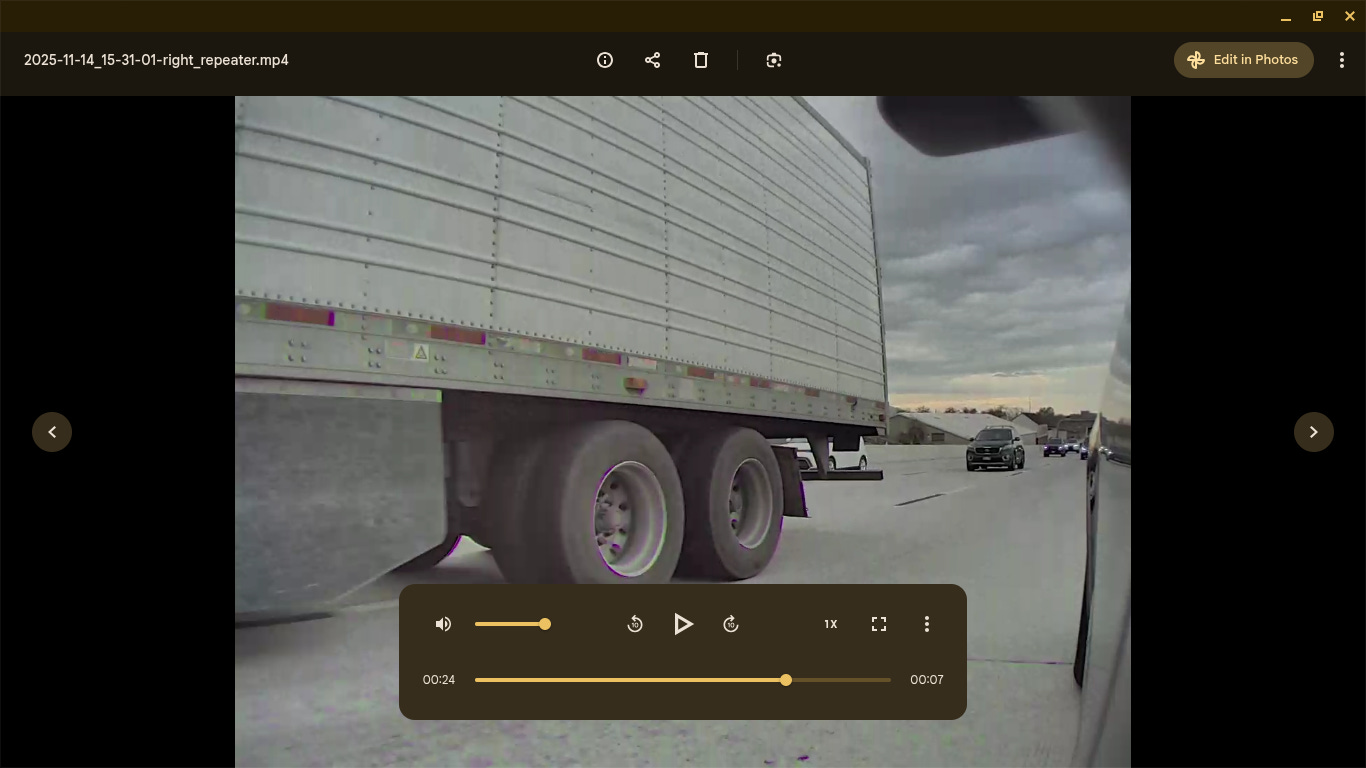
Instead of getting lazy (er) on my lane following, as I did with the rental I drove to California, and fighting a battle of wills with my daughter’s car over how much I let it do for me, my Tesla has taught me some things about my bad driving habits. First, I’m a rebel when it comes to staying in the middle of the lane, and also, I don’t seem to care about lanes or lines at all when there are no other cars around. Second, as it turns out, I’m very semi-shy, leaning as far as I can away from trucks (lorries) in the neighboring lane. Still, this car has several times already roused my attention and nudged me back into the lane when I’ve dozed off a little. It has also become more patient with my tendency to ride the line when passing eighteen-wheelers ever since one changed lanes into me. The car and I worked in perfect teamwork when I saw the danger a split-second before it did, and it helped me smoothly and safely change into the empty lane to the left of us, without warning me about crossing the line, or nudging the steering to prevent me, even though there was no time to signal. I didn’t even think to honk until afterward, and only later learned that honking the horn on a Tesla also saves the event in the running recording from the car’s array of cameras. I’ve included the event clip below.
Here is a better perspective…
In fact, while reviewing this footage for inclusion, I noticed that another Tesla passed me on the left just before this happened, so that another perspective might have been actually been captured by the rear camera of that car.
Since I originally wrote that last part last week, this has happened to me again since then, in thicker traffic, with the same favorable results.
Note: The Tesla software is still a work in progress, with both improvements in the product's intelligence and shifts in direction. This latest software update…2025.44.3…changed the content of this article a little bit, even while I was writing it. It still gets grumpy when I cross the line without signalling, but only if there is no apparent good reason.
I should also point out that an AI at Tesla constantly communicates with all Teslas, learning and continually improving the Full Self-Driving model to make it the safest way to drive. Currently, at this writing, Tesla Full Self-Driving is still supervised and uses the interior camera to ensure you’re awake and paying attention. Regulatory approval and final updates are still pending. Soon, maybe in the next couple of months, unsupervised Full Self-Driving, what I call “asleep at the wheel Full Self-Driving” will be made available.
Battery Management
Prior to the purchase, I’d already researched a number of things about this and had told people that the best way to avoid running out of battery is not to forget that it is not a gas car, and manage the risk with meticulous planning. Gasoline stores an enormous amount of energy, which the gas-powered vehicle uses very inefficiently. Comfort heating is provided by directing waste heat into the interior, and fans use an unmeasurably tiny proportion of the electricity produced by the generator and battery, which in turn uses an equally tiny portion of the energy available. Even a gas car’s air conditioning compressor, which operates on exactly the same principle as the refrigerator in your kitchen, still loads the engine much less than its own rotational drag. This load is at least measurable against the vehicle’s total miles per gallon, though only barely on most cars, and is unlikely to make enough of a difference to leave you stranded with an empty tank.
On a Tesla, all of that stuff matters, as do the locations of “filling stations”, in this case, Tesla Super Chargers. With the right adaptors, you don’t need a Tesla Supercharger to charge your Tesla, but the cost difference and the integration of their locations with the car’s navigation system make them the easy main choice for any repeated daily routine. I’ve learned that, despite my planning and forethought habits, I don’t need it when driving my Tesla. All I really need to do is carry and test the necessary adaptors just in case I ever need them. Also, to locate the Tesla Superchargers at my destinations and along my route, and plan how to visit them. Then, all I have to do is trust the car. It uses data from Tesla’s network of cars on the road. Their histories, along with an integrated central map of road conditions, ambient temperatures, elevation changes, and the like, can accurately predict the battery’s charge level at the destination if I drive conservatively…generally nailing it to within a couple of percentage points. If I use the navigator everywhere I go, and traffic weirdness, aggressive driving, or side trips unexpectedly cause me to use more energy than the car initially planned, the car will decide whether to stop to charge and will automatically add a route to a Tesla Supercharging station somewhere. Don’t ask Grok like I did a couple of times. Grok has led me astray on that score twice. In fact, Grok seems to be struggling with navigation at the moment. If you must use an AI on your phone to navigate, use Gemini (Google). In fact, when I say, “Hey Google, take me to __wherever__,” I can then share those directions with my Tesla app on my phone, and the route will then become the new route on my Tesla’s navigation console. I’m quite sure that if you combined that with Full Self-Driving, it would be extra cool, changing course without you ever taking your eyes off your phone! ;)
To charge your car, back up to the charger and get as close as you can without hitting anything, since the cord is a bit short. Then open the car’s charge port by tapping on it, plug the cord into the car, and go sit in the car while it charges. The system won’t work until you’ve programmed a credit or debit card in your Tesla account.
The car uses a similar technology battery to the one in your phone, and it turbo-charges the same way. It charges many times faster from lower levels of charge, and the battery will last longer if your daily charging stays below 80%. Tesla reinforces this by costing over twice as much for charging above 80% at crowded charging stations. At some chargers, late-night charging costs are roughly 30% lower than at other times. So, I’ve learned that since I start work early in the morning, running the battery below 20% and then topping off at the Tesla dealership in town before 6 am takes only 20 to 30 minutes if I use the navigator to precondition the battery for charging enroute and it costs me only $.25 per killowatt hour, where normal charging is closer to $.37.
Now that the polar vortex has weakened this winter, and the temperatures stay below 0 (and often well below) in this region, I prefer to top off the battery as soon as I arrive in my hometown, then recharge again cheaply when I get near work.
The Model Y…Sporty SUV.
My wife says it is like Dr. Who’s T.A.R.D.I.S…bigger on the inside. On the outside, it has the deceiving lines of an economy car, but, like the Cybertruck, it is actually much larger when standing next to it than you expect from a two-dimensional photograph. Even then, it still surprises you with its interior space. My four-year-old grandson even found some hidden storage space under the floor in the back. Comfort-wise, it has sporty tires with short sidewalls and minimal cushioning. If you’re like my wife and I, riding around with the huge tires and mass of a Silverado or Ford F-150 under you to absorb road noise, you will notice the difference. My geezer body arrives after long drives with almost the same aches and pains as when I drive the Silverado, and much less than when I drive the MV1.
Summary
I look forward to going to work every day, not just because of the new challenges, pay, and excellent, accepting, and exciting work environment. I very much love driving this car over the mountains for three hours every day.
My Science Fiction publication, AnomalyScifi…